


5 Mistakes that make software development cost more than expected

A software project may begin with a seemingly clear budget and still experience cost changes during delivery. The causes can include scope changes, new requirements, initial assumptions, or work that was not included in the original estimate; they should not be attributed to a single factor by default.
Unclear requirements, frequent scope changes, or trying to include too many features in the first release can all increase the amount of work. When every change leads to more design, development, testing, and handover work, the total cost can exceed the original estimate.
Table of Contents
1. Starting development while the scope is still unclear
2. Changing requirements without assessing the impact
3. Trying to include too many features in the first release
4. Looking only at the initial quote
5. Overlooking testing, handover, and maintenance
1. Starting development while the scope is still unclear
“We need an order management system” or “we want to digitize our internal process” does not provide enough information for a detailed estimate. Estimate reliability also depends on how clearly users, workflows, data, scope, and relevant constraints are defined.
If development begins while these points are still open, important details may only become visible after design or coding has already started. At that point, one new requirement may affect not only a single feature but also existing data structures, interfaces, and workflows.
For example, an initial “order management” scope may include only creating and updating orders. Later, the business may realize it also needs branch-based permissions, real-time inventory checks, and multiple delivery statuses. The amount of work is now significantly different from the original estimate.
Clarifying the scope does not mean defining every detail before development starts. What matters is identifying the factors that have the greatest impact on system structure and estimation early enough.
2. Changing requirements without assessing the impact
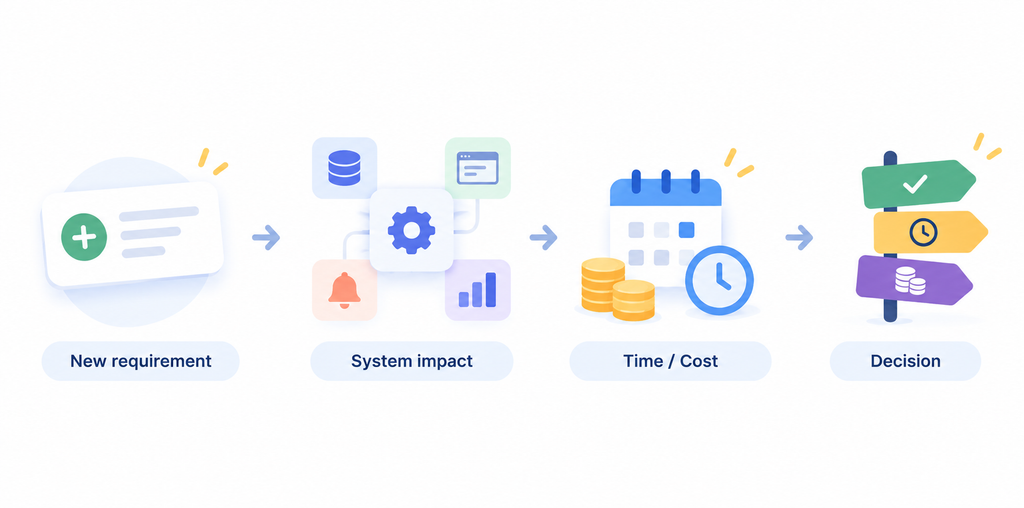
Changes can arise during software development, especially as requirements or business context become clearer. Risk increases when a new requirement is added without assessing its impact on timeline, budget, and scope.
A request that appears small, such as adding one more order status, may require changes to the database, management screens, notifications, reports, and testing. If the business looks only at the visible features, it is easy to underestimate the actual amount of work involved.
Before approving a change, at least three questions should be considered: which parts of the system will be affected, how much additional work will be required, and whether priorities or deadlines need to change.
When changes are documented and assessed clearly, the business can make an informed choice: add the feature, move another item to a later phase, or adjust the budget.
3. Trying to include too many features in the first release
When defining the first-release scope, additional requests may come from different stakeholders. If they are added without reassessing scope, timeline, and budget, the amount of work may increase beyond the initial plan.
If the project is delivered in multiple stages, not every useful feature needs to be included in the first release. The initial scope can prioritize the functions needed for the defined objective and intended use, depending on the project’s release strategy.
For example, an order management system may initially need order creation, inventory checks, status updates, and progress tracking. Advanced reporting, deeper customization, or multiple forms of automation can be added later once the core workflow has been validated.
Dividing scope into phases can reduce the amount that needs to be funded for the first release and create an opportunity to validate needs before expanding. The total cost of the product still depends on overall scope, changes, and how later phases are delivered.
4. Looking only at the initial quote
A lower quote does not always mean a lower total cost. If scope, change conditions, testing, handover, or post-release support are not clearly defined, additional costs may appear during development.
When comparing development options, businesses should look at what is actually included in the quote: whether requirements analysis is covered, how many revision rounds are included, what level of testing is provided, whether data migration is required, and who is responsible for fixing issues after release.
Two quotes may differ significantly because they cover different scopes, conditions, or deliverables. Comparing only the final number can overlook these differences.
The key question is not only “How much does it cost?” but also “What exactly does the business receive for this price, and which parts may cost extra later?”
5. Overlooking testing, handover, and maintenance
The total cost of a project or system lifecycle may include work beyond coding, depending on the contract scope and operational needs. Examples can include testing, production deployment, data migration, user guidance, and post-release support.
If these activities are not included from the beginning, additional costs may appear just when the project seems close to completion.
Maintenance costs should also be considered over the system lifecycle. Changes in the operating environment, business processes, or external services may require software updates. Limited documentation or heavy dependence on one person’s knowledge can make later maintenance and modification more difficult.
Before development starts, the business should clarify the testing scope, source-code and documentation handover, warranty period, post-release support model, and the responsibilities of each side.
6. How can businesses control costs more effectively?
It is not realistic to eliminate every change in a software project. A better goal is to make changes visible and assess their impact before they turn into unexpected costs.
Before development begins, the business should align on the problem to solve, primary users, current workflow, core requirements, and the scope of the first release. During delivery, each important change should be evaluated for its impact on scope, timeline, and budget before implementation.
Review points at different stages can help identify misalignment earlier. Reviewing prototypes, intermediate builds, or smaller deliverables creates opportunities to adjust before the amount of rework grows.
At Fenix, scope and requirements are clarified before development and continue to be tracked throughout the project. When changes arise, their impact on work and priorities is discussed first so the business can make decisions with clear information instead of discovering the cost only after the work has already been done.
7. Conclusion
Unexpected increases in software development cost rarely come from a single cause. Unclear scope, uncontrolled changes, an oversized first release, or post-development work that was not included from the start can all gradually push the budget higher.
Clear scope and priorities, together with impact assessment for changes, provide a stronger basis for tracking the budget and explaining why costs change during delivery.
If the current scope is still difficult to estimate or quotes from different providers vary widely, this may indicate that requirements, scope, or the assumptions behind each proposal need further clarification before deciding to begin development.