

When does a business need IT consulting?

Businesses usually turn to IT consulting when they know something needs to change but are not sure where to start. The issue may lie in workflows, data, the current system, or even the way technology investments are being prioritized.
What these situations have in common is that the business can see signs of a problem but may not yet understand the cause or direction. An analysis step before further investment can provide a stronger basis for defining the problem, comparing options, and evaluating the priority of potential changes.
Table of Contents
1. When manual work becomes a bottleneck
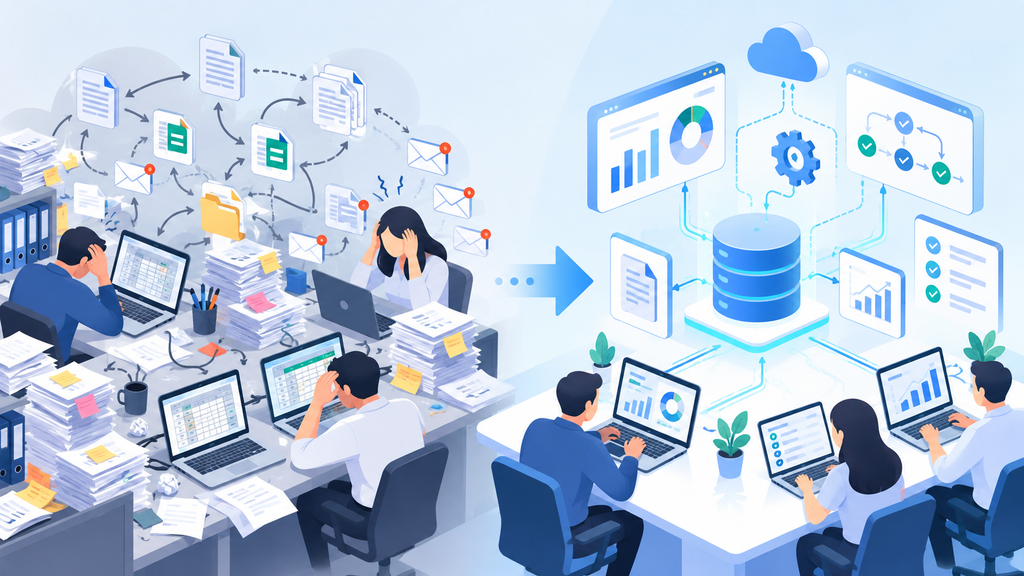
Excel, email, and simple tools can work well while the workload is still manageable. Problems begin when data has to be entered repeatedly, the latest version is difficult to identify, or employees have to complete too many steps outside the system.
These signs suggest that the business may not simply need a new tool. It may need a more consistent way to manage data and workflows. Replacing Excel with another application will not solve much if the underlying way of working stays the same.
At this stage, IT consulting can support an assessment of what may need standardization, which data may need centralized management, and which steps have a business case for automation.
2. When the current system can no longer keep up
A system that once met the business’s needs can become a constraint as the number of users grows, operations expand, or more tools and data sources need to be connected.
Common signs include employees creating workarounds outside the system, difficulty keeping data synchronized across teams, or increasing time and cost whenever a new function needs to be added.
The question should not simply be, “Should we replace the whole system?” The business needs to separate what still creates value, what can be improved, and what genuinely needs to be replaced.
A structured assessment before investing can help distinguish what still meets the need, what may need improvement, and what may need replacement instead of assuming that the entire system should change.
3. When technology investment has no clear priority
CRM, ERP, AI, and automation can be appropriate options in some contexts, but their value depends on the problem and how they are implemented. Without a clear objective, technology evaluation can become disconnected from actual operational needs.
Before choosing a solution, the business needs to identify which result matters most. That may be reducing processing time, limiting duplicate data entry, improving visibility, or helping teams work together more effectively.
Once the objective is clear, technology options can be evaluated more meaningfully because each one can be judged by the value it is expected to create.
4. When a software project is about to start but requirements are still unclear
“We need a management system” or “we want an app for customers” are reasonable starting points, but they are not enough to fully define scope or how the system should work. Depending on the delivery approach, some activities may begin while open points continue to be clarified.
If users, workflows, data, and expected outcomes are still unclear, the risk of changes or rework after development begins may increase. Those changes can affect timeline, scope, and cost depending on their impact.
Consulting before development can support clarification of the business context, identify requirements that need further analysis, and help evaluate which scope should be prioritized first.
These inputs give the business and development team a clearer basis for further requirements analysis or other next steps while aligning on the project objective.
5. When previous investment has not improved results
A new system does not automatically improve a process. If employees still return to Excel, only a small part of the system is being used, or processing time has barely changed, the issue may be the gap between the system and how the work actually happens.
At this point, adding more features may not be the answer. The business needs to review which parts of the workflow the system supports well, which parts users avoid, and whether the previous changes actually addressed the original problem.
IT consulting can support a reassessment of what has already been implemented and identify what may need adjustment before the business decides whether to continue expanding the system.
6. Conclusion
IT consulting is not used only before new system development. It is one option to consider when a business sees a need for change but the cause, priorities, or direction are still unclear.
At Fenix, consulting starts with the business context, workflows, data, and users before technology options are considered. The goal is to help the business identify the next step that fits its current situation rather than assuming every problem requires another new system.